
Case Study: Unforeseen Challenges Lead to an Aluminium Powder Explosion
An incident occurred when a company's order for aluminium powder was cancelled while the bulk truck was en route to a railcar hopper loading station. Without a standard operating procedure for offloading the powder back into the manufacturing plant, operators faced practical challenges in returning the material.
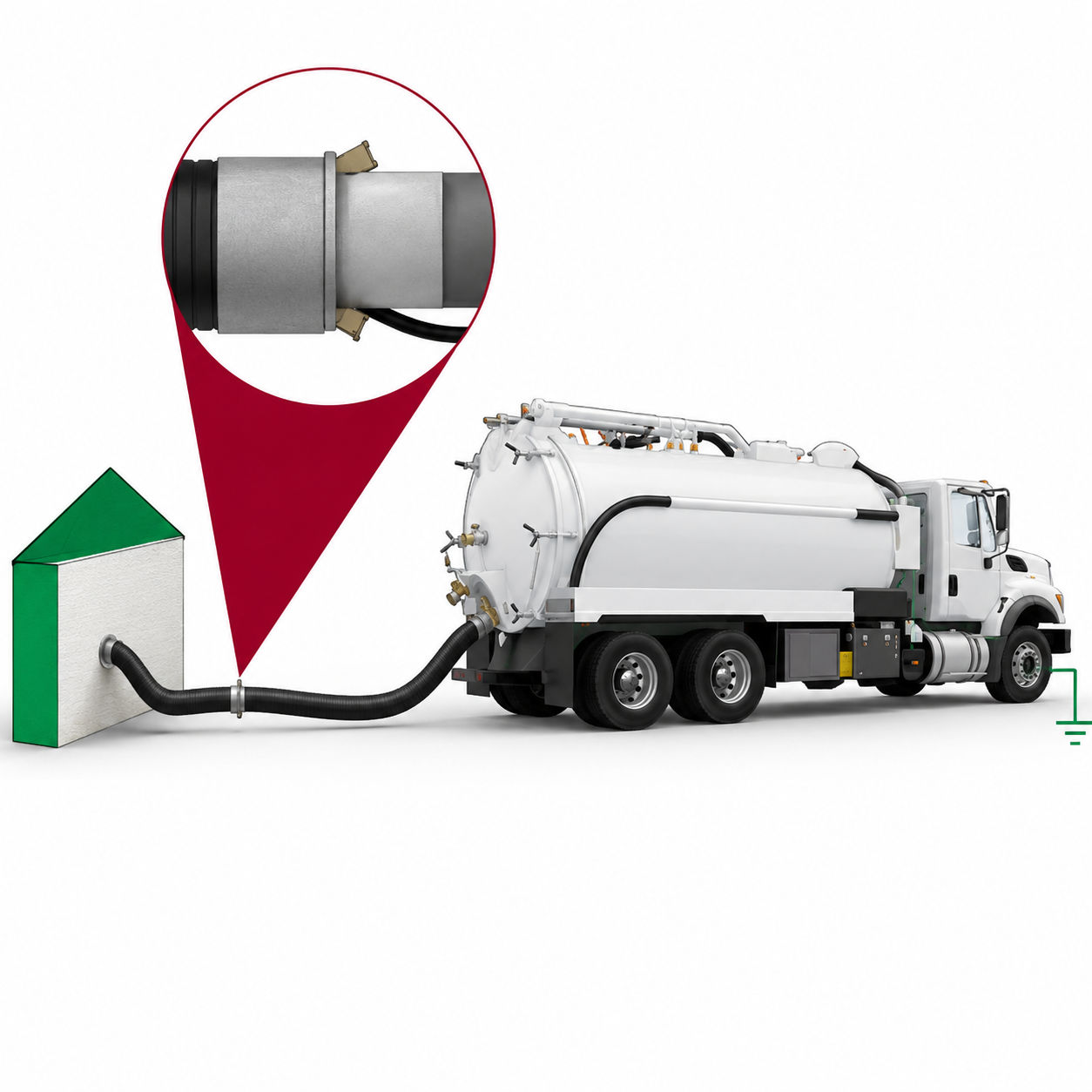
Upon the truck's return, it was discovered there was no direct loading point to inject the finished powder back into the production stream. Operators decided to use the truck's 3-inch hoses to convey the powder into the plant’s pneumatic transport system entry point. However, these hoses could not reach, necessitating the addition of an extra length of hose from the plant. Both the truck's hoses and the plant's hose were made of rubber tubing with internal metal helixes, designed to ensure electrical bonding of flanges.
While the truck was grounded, theoretically grounding the truck's hoses, a critical issue arose: the plant's hose was wider in diameter, preventing a sealed connection. Operators improvised by stuffing rags into the gap between the hose flanges. This action inadvertently electrically isolated the plant hose from the grounded truck, potentially hindering the transfer of electrostatic charges to ground. Additionally, the air-powder mixture coming from the truck was above the minimum explosive concentration for aluminium powder. Shortly after these improvisations, an explosion propagated throughout the plant.
The Physics of the Ignition: How a Spark Was Generated
Investigations revealed that the isolated plant hose had an estimated capacitance of 30 pico-farads. A modest streaming current, generated by the transfer of aluminium powder, was calculated to be around 10 micro-amps. The resistance to ground of the isolated hose's flange, which was resting on the concrete floor, ranged between 10^10 ohms and 10^9 ohms.
Based on these resistance values and the streaming current (V=RI), the voltage on the isolated hose was estimated to be between 10 kilo-volts and 100 kilo-volts. The energy (W) from a potential spark discharge (W = 0.5 CV^2) was calculated to be in the range of 1.5 milli-joules to 150 milli-joules. This energy level would have been sufficient to ignite an explosible concentration of aluminium dust, confirming the spark from the isolated hose as the likely ignition source.
Implementing Robust Static Grounding Precautions
In scenarios requiring improvisation, such as the one described, it is easy to overlook static grounding precautions. Electrostatic hazards are complex, especially when standard procedures are absent. A key measure to reinforce good practice is to train truck drivers to test the electrical continuity of hoses back to the grounded truck. This ensures that no transfer takes place unless all components in contact with the charged powder are properly grounded.
Drivers can perform a resistance check using an ATEX/HAZLOC certified ohmmeter or multi-meter. This check confirms that the combined resistance of the hoses does not exceed unsafe levels, allowing for effective charge dissipation.
Simplify Static Hazard Checks with OhmGuard®
For operations where concerns about correct meter usage exist, an even simpler solution is available: the ATEX/HAZLOC certified OhmGuard® tester. This device provides a clear visual indication to the operator, confirming whether the assembled hoses meet safe resistance levels.
Operating on a 'GO/NO GO' principle, the OhmGuard® is easy to use: simply attach one end to the truck and the LED indicator end to the interconnected hoses. The tester automatically determines if the resistance through the hoses is low enough to dissipate electrostatic charge. A pulsing green LED visually confirms that the system is safe, preventing ignitable sparks from discharging into combustible atmospheres.