
Introduction to Static Hazards
Static electricity, though cited as an ignition source for many fires and explosions, remains one of the most misunderstood and underestimated hazards in the industrial workplace. Even in environments where static is believed to be controlled, incidents can occur due to a lack of awareness, understanding, or disregard for its risk potential. This case study explores the repercussions and control measures following an incident where static electricity was the ignition source.
Source: 'Fire and Explosion of Highway Cargo Tanks, Stock Island, Key West, Florida'. Hazardous Materials Accident Report. NTSB, (1998).
Risks in Road Tanker Operations
Road tankers are essential for transporting dangerous materials, but loading and unloading flammable and combustible products present significant fire and explosion risks in industrial operations. Managing electrostatic hazards in such environments is a complex problem.
A 1967 study by the American Petroleum Institute (API) attributed static discharges to over 60 incidents in road tanker loading operations, highlighting a long-acknowledged threat. The risk of electrostatic discharge as an ignition source is exacerbated by absent or unsuitable grounding systems and the movement of product in flammable environments. Without adequate static grounding, charge levels increase, making a spark discharge highly probable.
Tank truck operations often occur in remote locations where designated grounding points may be unavailable or, if present, not regularly tested, leading to compromised low resistance connections to true ground due to environmental or lifecycle effects.
Regulators take static control precautions for road tankers seriously due to the inherent presence of static electricity in product transfer operations and its associated ignition hazards. Mitigating fire and explosion risks requires preventing the simultaneous presence of an ignition source and a flammable atmosphere. While not always possible to exclude both, precautions must control the risk effectively.
The Incident: Key West, Florida
In a specific incident, a road tanker driver was on top of his vehicle, inspecting compartment contents and preparing for material transfer, when explosive vapours ignited within the tanker. The ignition triggered an explosion that propelled him 75 feet from the truck. The subsequent fire and series of explosions injured the driver and destroyed his tanker and nearby vehicles. Damages were estimated at $185,000, and the driver sustained second and third-degree burns to his hands, arms, and legs, and a broken left knee, necessitating a three-month hospital stay.
Typical Applications for Specialized Vehicles and Mobile Plant Equipment
- Vacuum trucks
- Chemical spill and waste recovery service trucks
- Evacuating chemicals from reactors, storage tanks and containers
- Emergency response for hazardous/flammable tankers
- Mobile transfer pumps, blowers and mixing systems
- Refuelling aircraft and use of mobile bowsers
Understanding Static Electricity
Static electricity is a real and unseen threat. Any process involving relative movement generates static electricity through contact and separation of materials. The majority of plant equipment prone to static charge accumulation is metal. If a tanker's metal body is not grounded, it quickly becomes an isolated metal conductor, acting as the primary source of a static spark ignition hazard.
The Accident Details and Contributing Factors
The company, an intrastate private motor carrier, had a history of hauling bulk liquid petroleum products. The driver intended to transfer diesel fuel from a temporary storage tank. He arrived with a plastic bucket of mixed fuels (gasoline and diesel) that he believed had spilled previously. On top of the truck, he opened a compartment lid and began pouring the bucket's contents when flames erupted, and he was thrown. The accident report documented that the explosion or pressure surge necessary to propel the driver such a distance indicated an ignition and subsequent expansion of explosive vapours within a compartment, not an unconfined external ignition.
The investigation found no evidence of catastrophic failure of the front compartments, suggesting the pressure surge occurred through an opening, throwing the driver away from the explosion's center. This corroborated his recollection of standing near the compartment opening during ignition.
Despite the organization's longevity, road tanker loading and unloading operations are inherently dangerous. It is plausible that this operation had been conducted multiple times without incident, with electrostatic sparking occurring previously but without a flammable atmosphere present. This is common in static electricity-related incidents: charge can accumulate to dangerous levels even if it hasn't discharged.
Additionally, the driver's 'naive decision' to empty the bucket into a compartment with an unidentified fuel source was based purely on assumption, as the company lacked records of materials in the compartments. Drivers often 'switch load,' meaning they load diesel into compartments that previously contained gasoline, still holding vapours. Both the NFPA and API note that this creates dangerous conditions, as the atmosphere in contact with the rising oil surface may remain within the flammable range, making an explosion possible if a spark occurs.
Identifying the Ignition Source
The investigation focused on electrostatic discharge as the ignition source, ruling out other possibilities:
1. There was no lightning in the explosion area.
2. The nearby truck exhaust stack temperature (65° to 94°C) was insufficient to reach gasoline vapours' autoignition temperature (126°C).
3. While smoking couldn't be entirely discounted, and the driver was a smoker, there was no evidence he was smoking, and he confirmed this.
API: 2003 'Protection Against Ignitions Arising Out of Static, Lightning, and Stray Currents' defines the fundamentals of static electricity as "the accumulation of electrical charges on materials, the mechanisms by which charges are generated, and the processes of dissipating accumulated charges."
Electrostatic charge generation alone doesn't cause discharges; a high electric potential and electric field are required. Ignition occurs only when accumulated electrostatic charge provides sufficient energy to a flammable mixture. Hazardous electrostatic charges accumulate on bodies insulated from each other and ground. A typical ungrounded road tanker being filled at recommended flow rates can reach 10,000 to 30,000 volts within 15 to 50 seconds. This voltage range is highly capable of discharging a high-energy electrostatic spark to objects at a lower potential, such as operators or the filling pipe. Road tankers' large surface area allows for significant charge accumulation and very high voltages.
Factors Contributing to the Hazard
The most hazardous electrostatic situation in petroleum operations is charge buildup on an isolated piece of conductive equipment, like an ungrounded vehicle. Electrostatic sparks from isolated conductors are highly incendive, capable of igniting flammable mixtures. It was also assumed the driver was isolated from earth, and ungrounded personnel can carry over 30,000 volts, becoming a source of ignition in flammable atmospheres. Research indicates a historical lack of documented static ignition incidents from personnel electrification in the petroleum handling industry, likely because most outdoor or semi-enclosed operations are inherently conductive due to moisture/contamination, and personnel exposure to flammable atmospheres is limited.
Finally, the plastic bucket containing mixed fuels posed a serious threat. Charge can accumulate regardless of the contents' conductivity if the container is low-conductivity (non-conductive) or inadequately grounded. The NTSB documented that, due to static ignition concerns and other safety considerations, small portable containers should never be filled while in or on a vehicle, despite API allowance for their storage and transportation up to 45 liters.
Recommended Precautions to Prevent Incidents
- The tank and all associated equipment, such as piping, pumps and filters should be grounded
- Personnel entering or working near tank openings and compartments should be grounded
- Limiting the flow rate
- Splash filling should be avoided
Importance of Grounding Systems
The company lacked procedures for handling mixed fuels and did not require grounding and bonding cargo tanks, contradicting best practices outlined in API RP 2219 and NFPA 77. Static control measures are essential wherever ignitable mixtures are present. A grounding cable providing less than 10 Ohms resistance to earth must be connected from the loading system to the truck before any operation and remain connected until completion. Ideally, an interlock, like those in the Newson Gale Earth-Rite MGV system, should prevent operations without a connected earth cable.
Introducing a grounding system is crucial to mitigate charge buildup on both the product and surrounding objects/personnel.
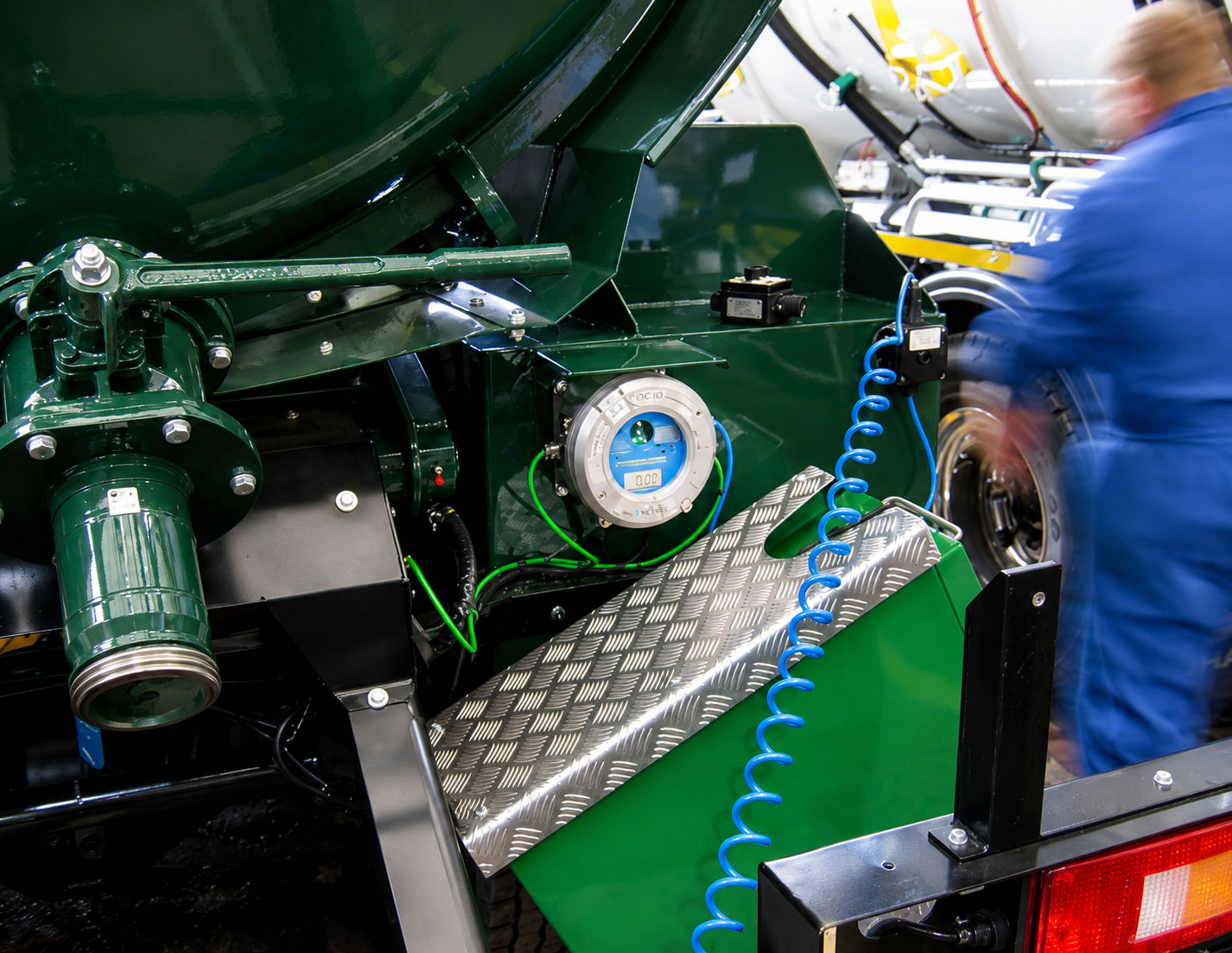
Vehicle-installed (Earth-Rite MGV) or gantry-fitted (Earth-Rite RTR) grounding systems empower operators and managers to enforce safety protocols, ensuring static grounding during product transfers. Using an Earth-Rite MGV system helps demonstrate compliance with international recommended practices.
API RP 2219 states: 'Before starting transfer operations, vacuum trucks should be grounded directly to earth or bonded to another object that is inherently grounded such as a large storage tank or underground piping.' It also specifies: 'This system (grounding) should provide an electrical contact resistance of less than 10 Ohms between the truck and a grounded structure.'
IEC TS 60079-32-1, 8.8.4 'Vacuum trucks' states: 'Vacuum trucks should be connected to a designated site earth before commencing any operations. ...When the truck is connected to a verified earth, the connection resistance between the truck and verified earth should not exceed 10 Ω for pure metallic connections or 1 MΩ for all other connections.'
Newson Gale Earth-Rite MGV System Operation
The Earth-Rite MGV system offers a user-friendly operator interface, indicating when transfer operations are safe to begin via flashing green LED lights. Operators connect a static grounding clamp to buried structural metalwork or ground rods. The system then performs 'Static Ground Verification' to confirm that the resistance to true ground is low enough (10 Ohms or less) to dissipate static charges from the truck's transfer system.
Once verified, the Earth-Rite MGV continuously monitors the connection resistance of the truck to the grounding point for the entire transfer process – this is 'Continuous Ground Loop Monitoring.' Both checks must be positive for ground status indicators to turn green. An additional safety layer can be achieved by interlocking the pump with the grounding system's relay contacts, automatically shutting down the transfer if the truck loses its ground connection.
Summary and Call to Action
Common causes of incidents include a low understanding of ignition sources, lack of awareness regarding electrostatic discharge safeguards, poor implementation of control procedures, and mismanaged transfer operations. The National Transportation Safety Board determined the probable cause of the accident was the 'company’s lack of adequate procedures and driver training, resulting in the driver’s pouring a mixture of gasoline and diesel fuel from a plastic bucket into a cargo-tank compartment that contained a mixture of explosive vapours.' The ignition likely resulted from a static discharge in the compartment due to the driver's actions. Even with over a decade of experience, inherent risks exist, amplified by the organization's lack of written standard operating procedures, which led the driver to consider unsafe practices as normal.
Recognizing the hazard is the first step. Regular static hazard awareness training combined with grounding equipment that demonstrates compliance with industry codes is vital for eliminating static electricity-induced fires or explosions. A HAZOP risk assessment report can identify hazards, evaluate risks, and guide control measures.
To help control these risks, Newson Gale offers a wide range of static grounding and bonding equipment designed for optimum safety in explosive atmospheres. Their range mitigates static charge accumulation through practical, innovative design, ensuring effective static control across three levels: grounding and bonding clamps, visual verification systems, and interlockable control systems.