
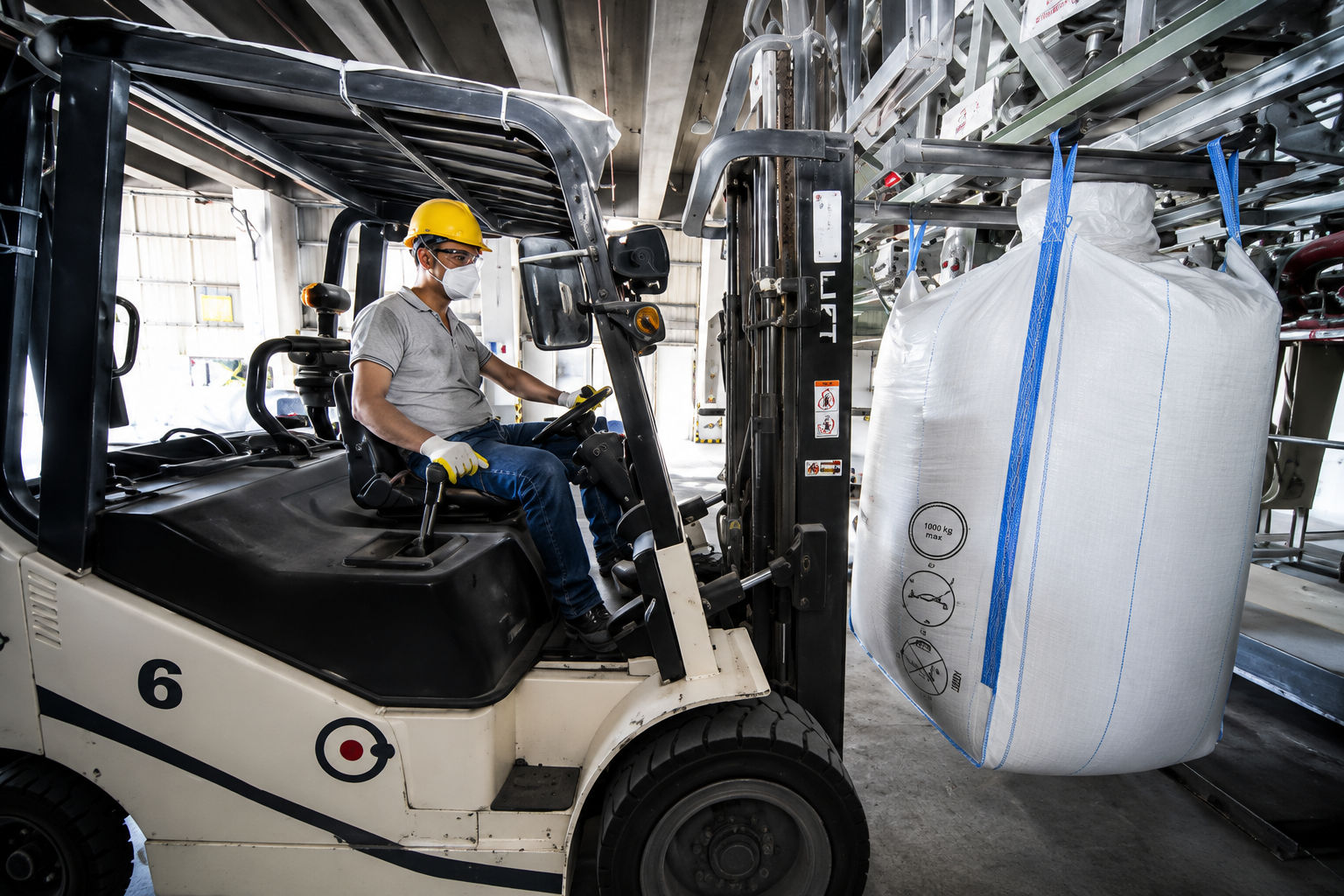
Understanding Static Electricity Hazards in Industrial Settings
Static electricity in a flammable or combustible atmosphere presents a significant risk of explosion due to electrostatic discharge. Identifying and controlling these electrostatic ignition hazards is crucial. This case study explores the factors contributing to static discharge ignition during Flexible Intermediate Bulk Container (FIBC) unloading operations, referencing 'Static Hazards Using Flexible Intermediate Bulk Containers for Powder Handling' by Laurence G. Britton (1993).
Flexible Intermediate Bulk Containers (FIBCs), introduced in the sixties, have been a major innovation for transporting dry flowable materials. Also known as 'bulk bags', 'big bags', or 'totes', FIBCs are made from flexible woven materials, typically high-strength thermoplastic polypropylene, often with a linear insert. They offer efficient and rapid transportation of bulk goods like sand, fertilizers, plastic granules, seeds, resin, and powder coatings, with 300-500kg typically unloaded in 30 seconds or less. Widely used in agricultural, chemical, food, and pharmaceutical industries, FIBCs are simple to use, cost-effective, strong, and more convenient than rigid IBCs as they can be collapsed and stored after use.
However, FIBC use is not without risks, especially when filling and emptying in hazardous areas. Electrostatic charge can accumulate on both the product contents and the fabric of the material itself. Often, the rate of static electricity generation exceeds the rate at which charges can dissipate, leading to a build-up of static electric charge within the process. The primary danger is that if this charge is released in the presence of a flammable atmosphere, an ignition can occur. Since many products are combustible, the inherent electrostatic discharge hazard from the material must be recognized and mitigated.
The severity of such incidents is highlighted by two separate events described in this case study, both involving the same operator. In the first incident, the operator suffered a singed head, a burn to the back of their neck, and a second-degree burn on their right arm. The second incident resulted in second and third-degree burns to their stomach and face, leading the employee to leave their role due to apprehension.
Case Study: Incident A - Ungrounded FIBC Leads to Flash Fire
The first incident involved a Type C FIBC bag used to transfer resin into a 6,000-gallon mixing tank for lacquer production. The mixing tank was equipped with thin conductive wires running lengthwise through the spout, connected to a bare stranded aluminum wire and an alligator clip. The FIBC was hoisted above the tank, and resin was dumped through a circular port on a hinged tank cover. Crucially, there was no independent venting for displaced vapor, and the tank lid was not gas-tight. Despite the operator noting that the ground wire was missing from the FIBC, he proceeded with the unloading operation.
With the tank lid open, solvent vapor readily escaped into the operating area. While it was not conclusively determined whether the fire occurred immediately or after the FIBC was nearly empty, the operator, standing near the tanker, observed a flash and turned away. Operators typically remain in close proximity to the FIBC during emptying to untie strings and shake out residual powder. In this scenario, an ignition occurred, and the operator was caught in the flash-fire zone, sustaining severe burns.
Analysis of Incident A: The Role of Ungrounded Equipment and Low MIE Materials
The investigation concluded that a spark discharge originated from the ungrounded FIBC during emptying. The lack of continuity to ground prevented the dissipation of static charge. Charge is retained on an insulated object due to the material's resistance, meaning a conductive FIBC must be isolated from earth to remain charged.
Given that the resin had a low Minimum Ignition Energy (MIE), flammable vapor was identified as a significant factor in the ignition process, likely reaching well in excess of acceptable levels. Materials with low MIE can easily achieve the minimum explosive concentration (MEC) during FIBC emptying, making them susceptible to combustion from various ignition sources. In this specific incident, electrostatic discharge was confirmed as the ignition source.
Although the operator was not grounded, static dissipative footwear would likely have been ineffective due to the potential presence of a lacquer film on the floor, common in processes involving coatings. Despite this, the operator was not considered a likely source of ignition.
Case Study: Incident B - Grounding Uncertainty and Operational Factors
The second incident involved the same operator and was similar to the first, but with a key difference: the FIBC was designed with an internal conductive aluminum liner bonded to the polypropylene in the spout, connected to an external grounding tab for a grounding clamp. The FIBC was suspended over the tank as before, and after the operator applied the grounding clamp, the discharge spout was pushed 10-12 inches into the tank's manway. The draw cord was then cut to open the spout and release resin.
On this occasion, the FIBC was not opened at the top for venting to mitigate drawing vapor into the container. When the flow was delayed, the operator 'puffed' the FIBC to free the flow. A flash occurred within 10 seconds of flow resuming. Failure to vent the FIBC was not believed to be a contributing factor, as there was no fire or explosion inside it.
In the event of an ignition during an FIBC operation, plant personnel in close proximity are highly vulnerable. The operator, once again near but not touching the FIBC, received second and third-degree burns to his stomach and face.
Analysis of Incident B: Inconclusive Grounding and Secondary Hazards
Unlike the first incident, it was reported in Incident B – though not conclusively determined – that a grounding connection had not been properly made, failing to ensure continuity to earth for static charge dissipation. However, the grounding clamp was unavailable for examination, making it impossible to fully ascertain the cause. Consequently, an FIBC operational error leading to a loss of continuity could not be ruled out, especially since the FIBC was destroyed in the fire. While polypropylene is ideal for FIBCs due to its unique qualities, it is also highly flammable and susceptible to ignition via spark discharge. Generally, FIBC operational failures often stem from manufacturing defects, operator error, or disabling continuity to a verified earth via a grounding clamp.
The sprinkler system above the tank failed to activate; however, pallets of resin bags were singed 20-30 feet from the tank. A significant hazard in any explosion is the dispersion of material into the plant area, potentially causing a secondary ignition. Although the hinged lid was closed, there was still no provision for venting either purge gas or air entrained into the tank by the powder flow, leading to a substantial displacement of flammable vapor into the operating area.
Mitigating Electrostatic Ignition Risks in FIBC Operations
To mitigate such incidents, the first step is to identify why electrostatic charge accumulates. Charge generation commonly occurs through triboelectrification, the contact and separation of material particles with equipment. Any material will naturally become charged this way. In FIBC processes, particle separation occurs between conveying equipment and the bulk bag during both filling and emptying, making these operations particularly prone to charge accumulation.
In the incidents described, electrostatic charge accumulated because the FIBC was isolated from ground, whether due to negligent operator actions or inconclusive grounding methods. Effective grounding, achieved with a Type C bag using either passive (single pole clamp and cable) or active (monitoring systems) means, would have verified connection to a true earth ground, thereby dissipating the charge.
Industry guidelines, such as NFPA 77 'Recommended Practice on Static Electricity' and IEC 61340-4-4 'Electrostatics – Part 4-4: Standard test methods for specific applications – Electrostatic classification of flexible intermediate bulk containers (FIBC)', specify acceptable resistance levels through the bag: less than 1 x 10^7 Ohms (10 meg-ohm) for NFPA 77 and 1 x 10^8 Ohms (100 meg-ohm) for IEC 61340-4-4. Given the significant charge that can build up on bags, an active grounding system is the recommended and safer choice.
Active grounding systems offer several benefits: they can determine if the bag's construction complies with relevant standards, ensure continuous grounding throughout the filling/emptying operation, and verify the correct functioning of static dissipative threads even after repeated use. This is crucial for preventing the use of non-Type C bags in hazardous areas.
Helpful Tips for Correctly Grounding Type C FIBC Bags
- Ensure that the selected grounding system can check and continuously monitor the full range of resistance through the bag.
- Ensure the grounding system not only checks the condition of the bag’s static dissipative threads but also ensures the ground circuit includes a direct and monitored connection to a verified True Earth grounding point.
- Avoid grounding systems that monitor only a limited percentage of the permitted resistance range, as they may pass faulty bags and reject acceptable bags.
- Ensure Type C bags are manufactured in accordance with the electrostatic recommendations of IEC 61340-4-4 or NFPA 77.
Newson Gale Earth-Rite® FIBC System for Enhanced Safety
Newson Gale’s Earth-Rite® FIBC system validates and monitors the resistance of Type C bags, ensuring their conductive elements can dissipate charges in compliance with necessary guidelines. Type C bags are specifically designed to dissipate static electricity via static dissipative threads interwoven into the bag material. Grounding tabs on the bags serve as connection points for grounding systems to prevent static charge accumulation.
Once two grounding clamps are connected to the grounding tabs, the Earth-Rite® FIBC system identifies if the bag operates according to the relevant standard. It achieves this by sending an intrinsically safe signal through the bag and verifying its return via a true earth ground (note: this is a static ground, not verified by the FIBC itself). Any accumulated charge on the bag is then safely dissipated through the static dissipative threads to the verified ground.
The static dissipative loop system continuously monitors the bag's resistance. Should it exceed NFPA 77’s limit of 1 x 10^7 Ohms or IEC 61340-4-4’s limit of 1 x 10^8 Ohms, a red LED on the remote indicator station illuminates, signaling to the operator that the system is no longer permissive.
Industry Standards for Type C FIBC Requirements
IEC 61340-4-4, 'Electrostatics – Part 4-4: Standard test methods for specific applications – Electrostatic classification of flexible intermediate bulk containers (FIBC)', specifies that a Type C FIBC intended for use in the presence of flammable vapors, gases, or combustible dusts with ignition energies of 3 mJ or less must have a resistance to groundable point of less than 1 x 10^8 Ohms when tested according to section 9.3. Additionally, the FIBC must be constructed entirely from conductive material or contain fully interconnected conductive threads or tapes with a maximum spacing of 20 mm for stripe patterns or 50 mm for grid patterns.
NFPA 77, Section 16.6.6.3, 'Type C FIBC', states that recommendations for conductive IBCs (given in 10.1.4) also apply to conductive FIBCs. A grounding tab, electrically connected to the conductive material or threads, is provided and intended for connection to a ground point during filling or emptying. The resistance between the conductive elements in the FIBC and the grounding tabs should be less than 1.0 x 10^7 Ohms. Always refer to and check the latest versions of International Standards, Guidance, and/or Recommended Practices.
Conclusion: The Importance of Comprehensive Static Control and Training
Advanced grounding systems offer additional benefits beyond basic clamps and cables, such as controlling product movement through output contacts interlocked with the process, preventing material flow without operator permission.
Recognizing the hazard is only the first step. It is often mistakenly assumed that simple clamps automatically mitigate static electricity risks. However, effective static dissipation requires careful planning and a robust approach to risk management. Even with the correct bag and grounding system, safety procedures can be circumvented by plant personnel, either purposely or inadvertently. As documented in Incident A, the severe effects far outweigh the time required for necessary checks and visual confirmation of operator clamping and a confirmed resistance to ground of 1 x 10^7 Ohms / 1 x 10^8 Ohms or less. Regular static hazard awareness training, combined with grounding equipment that visibly demonstrates compliance with industry guidelines, significantly contributes to mitigating fires or explosions caused by static electricity.
When a Newson Gale Earth-Rite® FIBC System Displays a Red LED
- The system is not in use.
- The grounding is compromised (exceeds 1 x 10^7 Ohms or 1 x 10^8 Ohms).
- The Type C bag’s construction does not comply with the relevant standards.