
Introduction: The Insidious Threat of Static Electricity
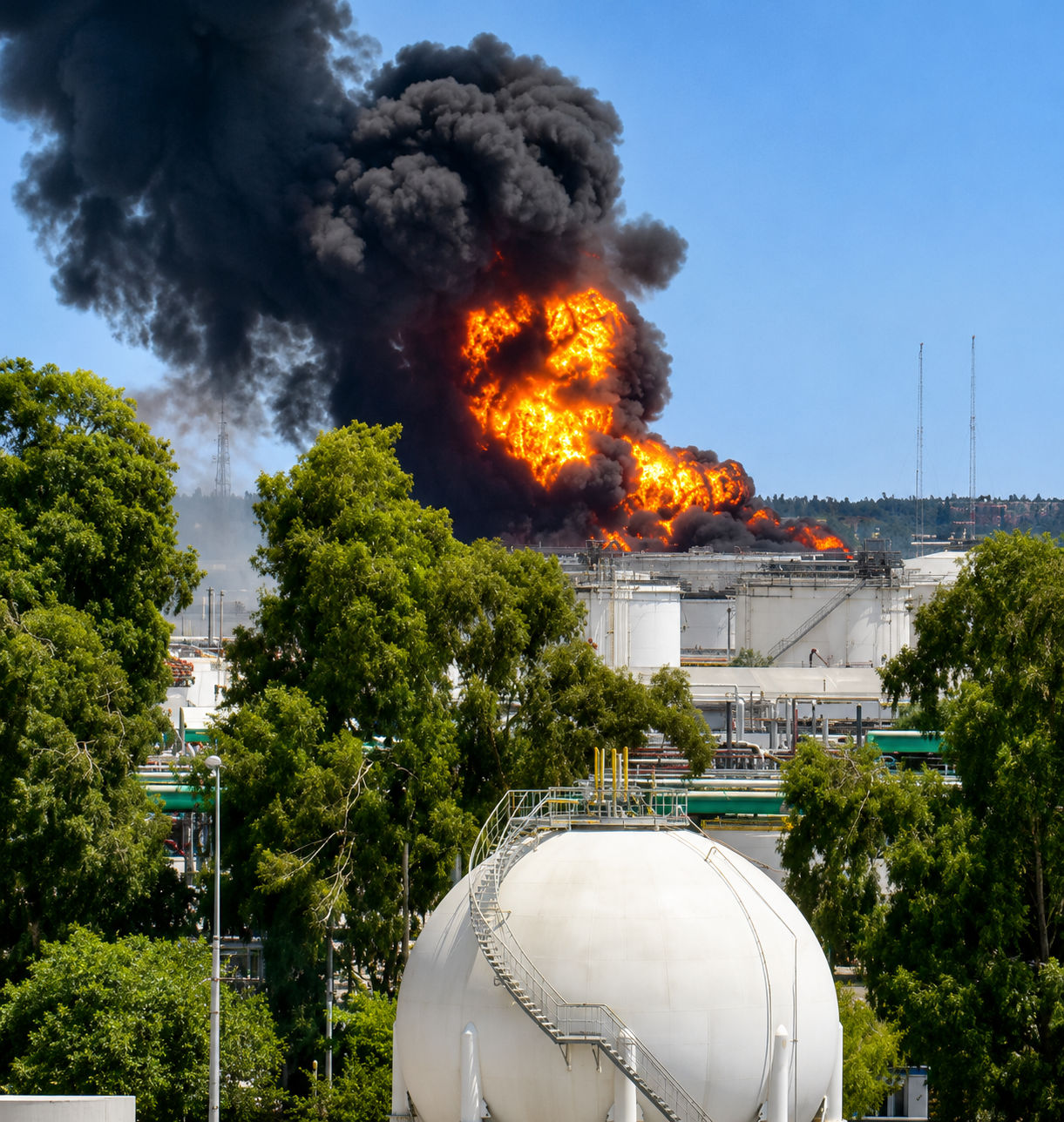
Uncontrolled static electricity poses a significant risk in industrial processing operations. While often associated with product movement in flammable environments, this case study, sourced from a 2018 Safety Alert on a tank explosion during HP activities, highlights how static electricity acts as an insidious ignition source during routine operations like storage tank cleaning. Newson Gale leads the way in hazardous area static control, providing solutions to these critical safety challenges.
Industrial processing, especially in oil refineries and chemical plants, involves storage tanks that contain vast volumes of static-accumulating flammable liquids. These tanks, varying in size, construction, and design (vertical, horizontal, open-top, closed-top), all share a common, unseen threat: the risk of an electrostatic discharge in hazardous industrial petroleum environments.
Understanding Static Accumulation in Metal Storage Tanks
Most process plant equipment prone to static charge accumulation is made of metal. While metals like copper and steel are excellent conductors with low electrical resistance to charge transfer, this beneficial property becomes a hazard if the metal body is not properly grounded. Isolated metal conductors are a primary source of static spark ignition hazards. Given that storage tanks are predominantly made of steel, they can release accumulated charge in a single incendive spark, capable of igniting flammable vapours.
Oil refineries typically feature 'tank farms' to ensure uninterrupted operations. Although within fire and bund walls, these tanks are often in close proximity. While their layout should adhere to minimum separation distances, primarily determined by tank capacity, the Health and Safety Executive (HSE) notes that these distances are unlikely to offer complete protection against fire or explosion. They primarily allow sufficient time for evacuation, given adequate escape routes.
A single storage tank fire can quickly escalate into a chain reaction throughout a facility, leading to severe financial losses, production interruption, and potential loss of life. Therefore, a two-fold approach is crucial: first, understand potential ignition sources within hazardous areas, and second, implement measures and standard operating procedures to mitigate such incidents.
Case Study: A Tank Cleaning Incident
Tank vessel explosions have occurred without a clear probable cause, but with static electricity identified as a potential ignition source. In some instances, poor adherence to safe procedures was indicated. The persistence of these accidents suggests systemic operational safety deficiencies. This incident underscores static electricity's severity as an ignition source, even in routine tasks like tank cleaning.
In one particular incident, a site employee was cleaning a storage tank partly filled with sludge (a mix of production process water, petroleum residues, and sand) when an ignition occurred, causing an explosion. The hose operator, next to the tank opening, saw a flash and immediately ducked, sustaining minor facial burns despite his efforts.
The high rate of charge generation and exposed flaws in the cleaning activity, coupled with the operator's injuries, prompted a thorough review. The investigation scrutinized the operating procedure, including a lack of accurate information on flammable products within the vessel, and the grounding and bonding integrity of the storage tank. Subsequent inspections led to crucial lessons learned and recommendations for on-site changes.
The Mechanism: Electrostatic Charge Generation from Mists
During petroleum storage tank cleaning, static electricity accumulates due to splashing against the tank surface. This accumulated charge, especially when using cleaning chemicals, must always be considered and expected to be high. Preventing static accumulation is critical during all tank washing operations due to the vigorous agitation of liquids involved. In the incident, a high-pressure water jet used to remove deposits inadvertently created a fine electrostatically charged mist in the tank space, which was then ignited by a static discharge.
A 'mist' refers to a collection of liquid droplets suspended in a gas medium, typically having lower momentum than sprays and behaving more like a quiescent cloud. Mists formed during water washing (or from steam introduction) can become electrostatically charged. In the incident, this charging created an electrostatic field throughout the tank.
When a spark occurs between two conductors submerged in such a mist, the temperature rapidly increases within a small, roughly spherical volume of gas and droplets, known as the spark kernel. Within this volume, fuel droplets rapidly vaporize, mixing with the surrounding air. High temperatures lead to extremely fast reaction rates, transforming fuel vapour into combustion products and releasing heat.
The minimum ignition energy (MIE) required for a self-propagating flame in a mist is influenced by several factors: droplet size (most significant), fuel concentration, volatility, air velocity, and the presence of any fuel vapour. Increased fuel volatility reduces the energy needed to vaporize droplets, thus lowering the ignition energy.
Incident Contributing Factors
- Fuel: 'sludge' containing petroleum residue.
- Atmospheric conditions: Hot, creating a flammable/combustible atmosphere.
- Ungrounded storage tank: Isolated from earth, allowing charge accumulation.
- Ignition source: Static electricity.
- Ungrounded conductor: The cleaning hose and operator.
Uncovering the Root Causes and Consequences
The investigation revealed that the 'sludge' was incorrectly assessed as non-hazardous, meaning tank cleaning activities were not planned as high-risk. The incident also occurred on a particularly hot day, which likely accelerated nebulisation (liquid conversion to fine spray/mist). Crucially, with no grounding in place, charge accumulated freely, rendering the tank an isolated component holding large amounts of static electricity. This build-up eventually discharged a spark onto an object at a different potential, attempting to equalize the charge and leading to ignition.
Essential Safety Measures and Prevention
A proactive approach, including the installation of a suitable grounding and bonding solution, is highly recommended. The rate of charge generation is notoriously difficult to predict, making static control measures essential to mitigate electrostatic ignition risks. Generated charge becomes a problem in hazardous areas only when allowed to accumulate on ungrounded objects. The most critical action is to ensure all conductive objects are connected to a verified earth. Ignoring electrostatic discharge dangers in hazardous environments jeopardizes both personnel and plant.
A literature survey (Santon, 2009) highlighted the severe consequences of mist explosions, identifying 37 incidents, including 20 explosions, with 9 collectively responsible for 29 fatalities.
Key Recommendations for Static Control
- The optimal solution provides operators with a visual means to verify a connection to equipment at risk of static charge accumulation, with a resistance of 10 Ohms or less. IEC TS 60079-32-1 states that 'metallic items in good contact with earth should have a resistance to it of less than 10 Ohms.'
- IEC TS 60079-32-1, 13.3.1.4, regarding 'Movable metal items,' recommends that objects be earthed by an alternative means (e.g., earthing cable) with a connection resistance of 10 Ohm. Earthing and bonding must be continuous throughout the period when charge build-up could occur and cause electrostatic hazards. Always refer to the latest versions of international standards, guidance, and recommended practices.
Protecting Personnel: The Importance of Footwear Testing
Beyond equipment, the operator's path to earth is critical. People can generate over 30,000 volts of static charge through their movement if not grounded, posing a significant ignition risk. Conclusive measures must be implemented to ensure that static dissipative footwear effectively dissipates static through shoes to ground. Regular testing of such footwear is strongly recommended to confirm its static dissipative properties are maintained throughout its use. The provision of footwear alone is insufficient; its proper maintenance and functional capacity, undetectable by visual inspection, are paramount. Organizations must ensure that employees operating in flammable and combustible hazardous environments wear footwear capable of dissipating electrostatic charges.
Preventing charge accumulation on plant personnel is straightforward, relying on correct footwear and the ability to test its properties before entering a hazardous area. An electrical resistance test would have been recommended prior to the tank cleaning operation.
Newson Gale's Sole-Mate™ II tester offers a time-efficient and cost-effective method to ensure personnel in hazardous areas wear static dissipative shoes that limit electrostatic charge accumulation on their bodies. This system tests footwear condition and measures resistance, confirming static can dissipate safely from personnel to ground.
Advanced Grounding and Interlocking Systems
The Earth-Rite® PLUS™ grounding system from Newson Gale combines a simple visual GO/NO GO indicator (traffic light model: red/green) with interlock control capability. Interlocking with the process is the most effective way to control static electricity ignition risks during operations. Conductive objects like storage tanks, skids, IBCs, and rail cars can accumulate hazardous electrostatic charge levels, discharging static sparks with energies far exceeding the ignition energy of many combustible gases, liquids, or vapours.
The Earth-Rite PLUS system continuously monitors the connection to ground, ensuring static is safely dissipated throughout the operation. If the connection breaks, a red NO GO ground connection LED activates, and the interlock contacts open. The system boasts full ATEX and IECEx certification for all gas and liquid groups and ensures a connection resistance of 10 Ohms or less between the tank and the product transfer system.
Lessons Learned from the SIR Accident Report (March 2018)
- During joint risk assessments, always ensure correct product information is supplied by the client and that the cleaning technique used by the cleaning company is appropriate.
- Industrial cleaning of sludge can create an explosive atmosphere, as hydrocarbons in the sludge can form a mist when stirred up.
- In industrial cleaning activities, all potential ignition sources (e.g., static electricity, short circuits, non-EX equipment, flammability of the medium) must be eliminated or controlled as fully as possible.
- Since complete control of all potential ignition sources isn't always possible, explosive atmospheres must not be allowed to build up in the tank, and continuous measurements must be taken.
- The procedure for rendering equipment safe must focus on creating a safe workspace throughout the entire activity, not just at the start.
Conclusion: A Multi-Layered Approach to Static Control
Ignition risks arise in various ways, and static electricity during tank cleaning operations is a prime example. It's crucial to understand how these risks originate and implement the necessary precautions for a safe working environment. By mitigating charge and the potential for uncontrolled electrostatic discharge, the resulting ignition risk can be eradicated.
The primary mindset should be to identify a grounding solution that offers the highest level of protection and can be integrated with existing operations. Deploying multiple layers of protection against ignition sources ensures static is controlled safely, repeatably, and reliably, day in and day out. For more information or questions on this case study, contact Newson Gale or visit the Earth-Rite® PLUS™ product webpage.