
The Persistent Threat of Dust Explosions
Dust explosions in hazardous processing environments are a long-standing threat, with static electricity often being a potential ignition source. The earliest recorded incident dates back to Giacomelli’s Bakery in Turin, Italy, in 1785. In this event, flour dust, which can become combustible when dry and charged with static, ignited upon contact with a mounted lamp. A dispersed cloud of flour, originating from flour dropping from an upper warehouse, resulted in an explosion that injured workers and demonstrated the violent nature of dust explosions, providing an early insight into the 'dust explosion pentagon'.
Unlike the fire triangle, a dust explosion requires five elements: fuel, oxygen, an ignition source, the dispersion of dust particles in the right concentration, and the confinement of the dust cloud. Dispersed airborne dust burns rapidly, and confinement allows for pressure build-up. By definition, combustible dust is any fine material capable of catching fire and exploding when dispersed in air. These explosions emit energetic forces, creating powerful pressure waves that cause significant damage to plants and severe harm, including burns, injuries, and fatalities, to people.
Understanding the Dust Explosion Pentagon and Its Devastating Impact
History tragically testifies to the human and economic cost of dust explosions. A 2006 US Chemical Safety Board (CSB) report identified 281 combustible dust incidents between 1980 and 2005, resulting in 119 worker deaths, 718 injuries, and numerous damaged facilities. In the UK, the Health and Safety Executive recorded 303 dust explosions over a nine-year period, while German records show 426 similar incidents over 20 years.
Tragic incidents continue to cause significant business interruptions and loss of lives. Over half of dust explosion incidents are attributed to four key industry sectors: food products, wood products, chemical, and metal. The average dollar loss per explosion incident in a typical year is an estimated $3.4 million. Dust is a hazardous by-product across many industries, from powder handling to sophisticated manufacturing processes. Industries susceptible to dust explosions include coal, wood, waste recycling (paper), agriculture, chemical, and metal processing.
Defining Combustible Dust and Key Ignition Factors
The National Fire Protection Association (NFPA) 654 defines dust as “A combustible particulate solid that presents a fire of deflagration hazard when suspended in air of some other oxidizing medium over a range of concentrations, regardless of particle size or shape”. Many organizations are unaware that their processes can produce an explosive atmosphere, with dust being an innocuous-seeming consequence of normal manufacturing.
Dust explosions occur when dispersed combustible material reaches a high enough concentration, meaning a hazard exists when dusts are produced, stored, or processed and become airborne. When processed products are combustible and contain a significant portion of fine material, the explosion potential dramatically increases. Fine powders with low Minimum Ignition Energies (MIE) regularly reach the Minimum Explosive Concentration (MEC) in conveying systems, making them vulnerable to various ignition sources, including electrostatic discharge. The MIE for a powder depends on its fineness; very fine particles tend to have the lowest MIE values. While special static electricity measures may not be necessary if MIE is above 10 millijoules (and no flammable gases/vapours are present), precautions may still be required for conductive plant equipment to minimize electric shock risks to operators. Ignition energies are typically low in chemical and pharmaceutical industries (especially in hybrid flammable dust/vapour atmospheres) but somewhat higher in the food industry. Finer particles are more explosive due to their large surface areas, which allow them to react rapidly with oxygen when dispersed in air and ignite. NFPA 654 defines dusts as 420 microns (μm) or smaller (e.g., table salt is around 100 microns).
Primary Ignition Sources for Dust Explosions
- Electrostatic ignition
- Friction
- Electrical arcing
- Hot surfaces
- Fire
- Self-ignition
The Catastrophic Chain Reaction: Primary and Secondary Explosions
One of the main dangers of a dust explosion is the chain reaction it creates, forming a self-sustaining domino effect as long as fuel is available. There is often both a primary and a secondary explosion, allowing for a transition from fire to multiple explosions and vice versa.
A primary explosion usually occurs inside a process vessel such as sieves, dryers, mixers, conveying systems, and silos, where the five elements of the dust explosion pentagon are met. The resulting impact of this primary blast often ignites a secondary explosion. Unburned fuel from the primary explosion is ejected outside the enclosure, causing dust accumulated on floors or other surfaces to become airborne and susceptible to ignition. A secondary explosion can be more destructive than the primary due to the increased concentration of dispersed combustible dust and a potentially greater ignition source. The shockwave from a primary explosion will damage and often rupture the self-contained vessel, allowing the explosion to propagate throughout the plant, leading to catastrophic results, especially if structural integrity is already compromised.
Tragedy at Imperial Sugar: A Wake-Up Call for Dust Hazard Management
The 2008 Imperial Sugar explosion at their refinery in Port Wentworth, Georgia, US, claimed 14 lives and critically injured 36 workers. A year prior, the company was one of the largest sugar refineries in the US, producing 1.3 million tonnes. A series of violent sugar dust explosions obliterated the site, destroying 12% of the 160-acre facility. A CSB investigation concluded that all 14 casualties were “most likely the result of the secondary explosions and fires”.
Despite operating for over 80 years without a devastating dust explosion, the facility had a history of long-standing problems with accumulated sugar dust and spilled sugar from 1970–2007. It is likely that while conditions suggested an incident could occur, the sugar dust never accumulated to levels above the minimum explosible concentration (MEC) until the fatal event. Internal correspondence documented “knee deep” levels in some areas, and an inspection two months prior showed tonnes of sugar accumulating on the floor, providing much of the fuel for the secondary explosions. The primary dust explosion occurred inside an enclosed steel conveyor belt used to transport granulated sugar. Airborne combustible sugar dust accumulated above the MEC inside the unit, with an overheated bearing identified as the likely ignition source, triggering huge secondary explosions and fire throughout the packing buildings.
The CSB reported that to protect against debris and contamination, Imperial Sugar had enclosed belt assemblies with stainless steel frames. These panels, removable for cleaning, lacked dust removal or explosion venting systems, essentially confining sugar and harnessing product accumulation. Imperial Sugar CEO John C. Sheptor stated, “accumulated sugar likely acted like gun powder” and called combustible dust “a silent risk that needs to be addressed”. As Gibbs concluded in ‘The Dust Hazard in Industry’, “Sugar, dextrin, starch and cocoa are the most dangerous, sugar exceptionally so.”
In the aftermath, The Occupational Safety and Health Administration (OSHA) cited Imperial Sugar for 108 instances of “wilful violations related to the combustible dust hazard,” including failure to clean dust and not using appropriate equipment or safeguards. The proposed fine of $8.7 million was, at the time, the third largest in history. This incident starkly highlights the devastating effects that dust explosions can have on people, businesses, communities, and the economic climate.
Proactive Static Control in Powder Processing: Essential Safeguards
In manufacturing and handling process industries within flammable and combustible atmospheres, the threat of static electricity is ever-present. Certain types of dust handling plant equipment, such as mills, conveyor belts, and pneumatic conveying systems, readily generate static electricity. In potentially explosive atmospheres, the energy from spark discharges from plant, equipment, and even people can be sufficient to ignite many fine dusts produced during the handling of loose solids like powder, granules, pellets, and flakes. Electrostatic charging of isolated plant equipment or materials is highly probable when moving dusty materials in quantity.
It is fundamentally critical to take necessary precautions to mitigate discharges powerful enough to cause ignition of a dust cloud. All potential sources of internal and external static discharges from process equipment in zoned and classified areas must be accounted for and managed appropriately. If not sufficiently bonded and grounded, isolated components in conveying and dust collection systems can hold large amounts of static electricity. Such isolation often results from design oversights or maintenance teams reassembling fittings without re-establishing static bonding connections. Pipes, valves, blowers, hoppers, and other components in powder transfer processes can become isolated due to insulating properties of parts like rubber gaskets or general wear and tear.
The most secure method of mitigating charge build-up is to bond and ground components to a reliable, verified earth. Although static electricity generation and accumulation are invisible and discrete, they pose a very real possibility of discharge igniting combustible atmospheres. To mitigate electrostatic discharges igniting combustible dusts, companies should risk assess their processes and equipment to identify and correctly manage all potential ignition sources. Each explosion threat presents unique challenges, with variables like combustible material, ignition source, process vessel, operational procedures, and environmental conditions all impacting risk severity. Practical solutions include grounding/bonding, explosion venting, suppression, and isolation.
Static grounding and bonding systems aim to eliminate static as an ignition source, removing a key element of the dust fire pentagon. While completely mitigating dust-related explosion risks isn't always possible, measures must be taken given the potential for extensive losses of human life, facility damage, and production downtime. The nature of powder processing means static electricity generation is expected throughout the system due to particle movement. Regular maintenance is crucial to prevent material clogging, but disassembly for cleaning can lead to missed or incorrectly made bonding connections upon reassembly. Vibration and corrosion can also degrade connections. It is imperative to ensure no parts become isolated from a true earth ground.
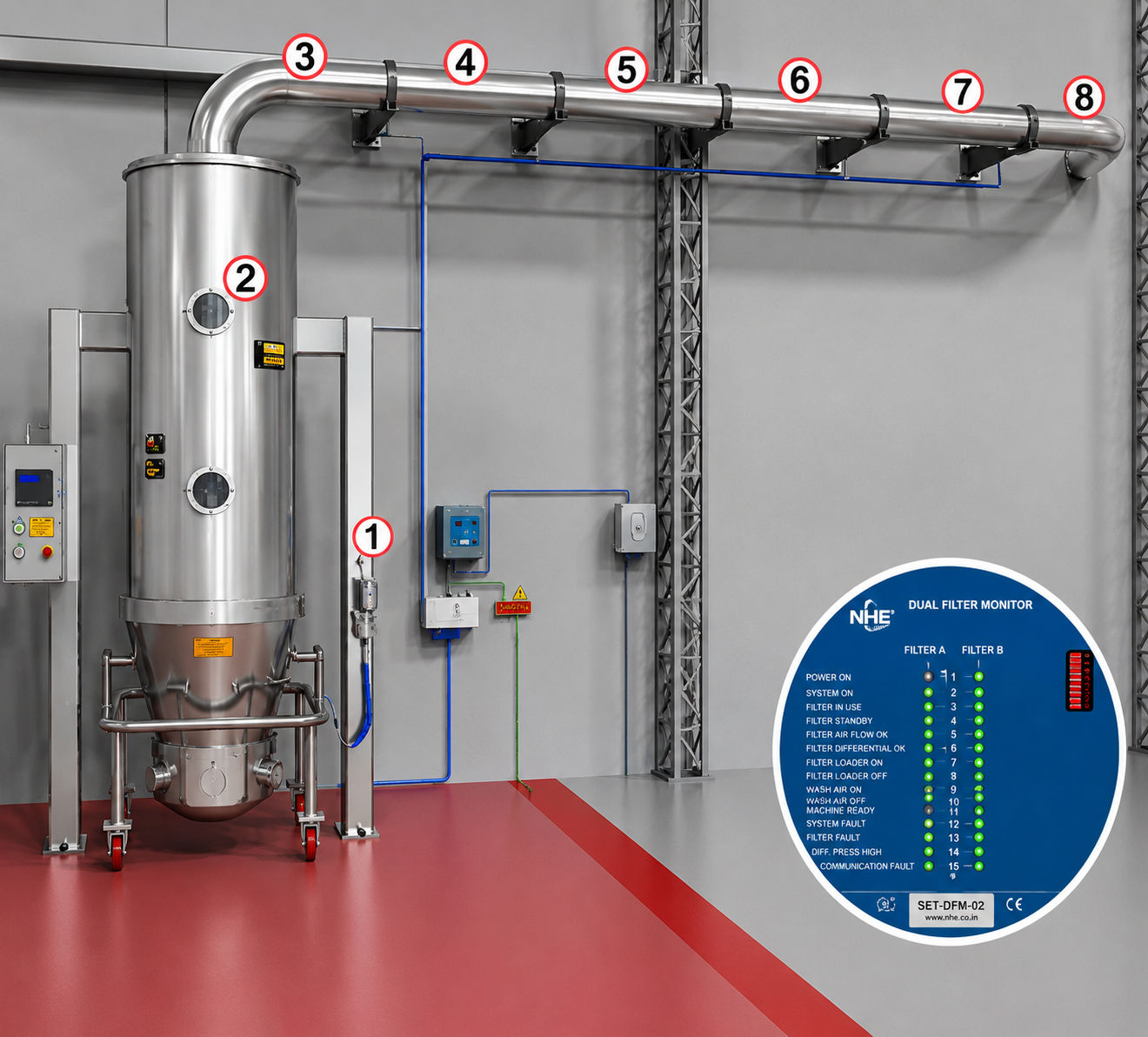
The most effective way to prevent complex powder processing equipment from accumulating static electricity is to provide a dedicated static grounding solution, such as Newson Gale’s Earth-Rite MULTIPOINT II system. This system monitors ground connections to components at risk of isolation, capable of halting product flow and alerting personnel to potential hazards if a component loses its ground connection, especially critical when ground points are not readily visible or accessible. Powder processing equipment presents a greater challenge than standard applications, as metal parts within larger assemblies can be electrically isolated from each other.
Risks of Removable Sections Becoming Isolated Conductors
- Each section does not have a sufficiently low path to ground to safely dissipate charge.
- The correct reassembly of equipment after cleaning between operations and regular examination of bonding straps between the metal pipework and duct sections by plant personnel is not routinely carried out.
Comprehensive Strategies for Dust Explosion Mitigation
Given the hazards that exist within industry today, good housekeeping, strict maintenance practices, and ignition risk identification and mitigation are paramount in preventing dust explosions. One of the most important mitigation measures is maintaining a clean working environment, as accumulated dust deposits provide fuel for secondary explosions. To mitigate against uncontrolled static discharges posing a fire and explosion hazard in powder processing operations, a thorough static audit by qualified personnel should be carried out. For situations where potentially isolated components are identified, dedicated grounding equipment, such as the Earth-Rite MULTIPOINT II, should be installed to monitor and control the release of static electricity, thereby removing a primary source of ignition in combustible dust atmospheres.
Key Considerations to Mitigate Dust Cloud Accumulation
- Maintain a plant in a leak-tight condition (address damaged seals, loose bolts).
- Reduce labor involved in cleaning by designing plants with a minimum number of horizontal ledges where dust can settle.
- Electrical plant equipment may be at risk of overheating if dust deposits settle.
- Introduce technical measures to safeguard against an explosion.