
Introduction to Electrostatic Hazards
Newson Gale's series of articles highlight how a wide range of industrial processes are susceptible to electrostatic charge generation and accumulation on both portable and fixed plant equipment. These charges can lead to fires and explosions, as documented in resources like "Electrostatic Ignition of Fires and Explosions" by Thomas H. Pratt (CCPS, 2000).
The Incident: Manual Powder Transfer Ignition
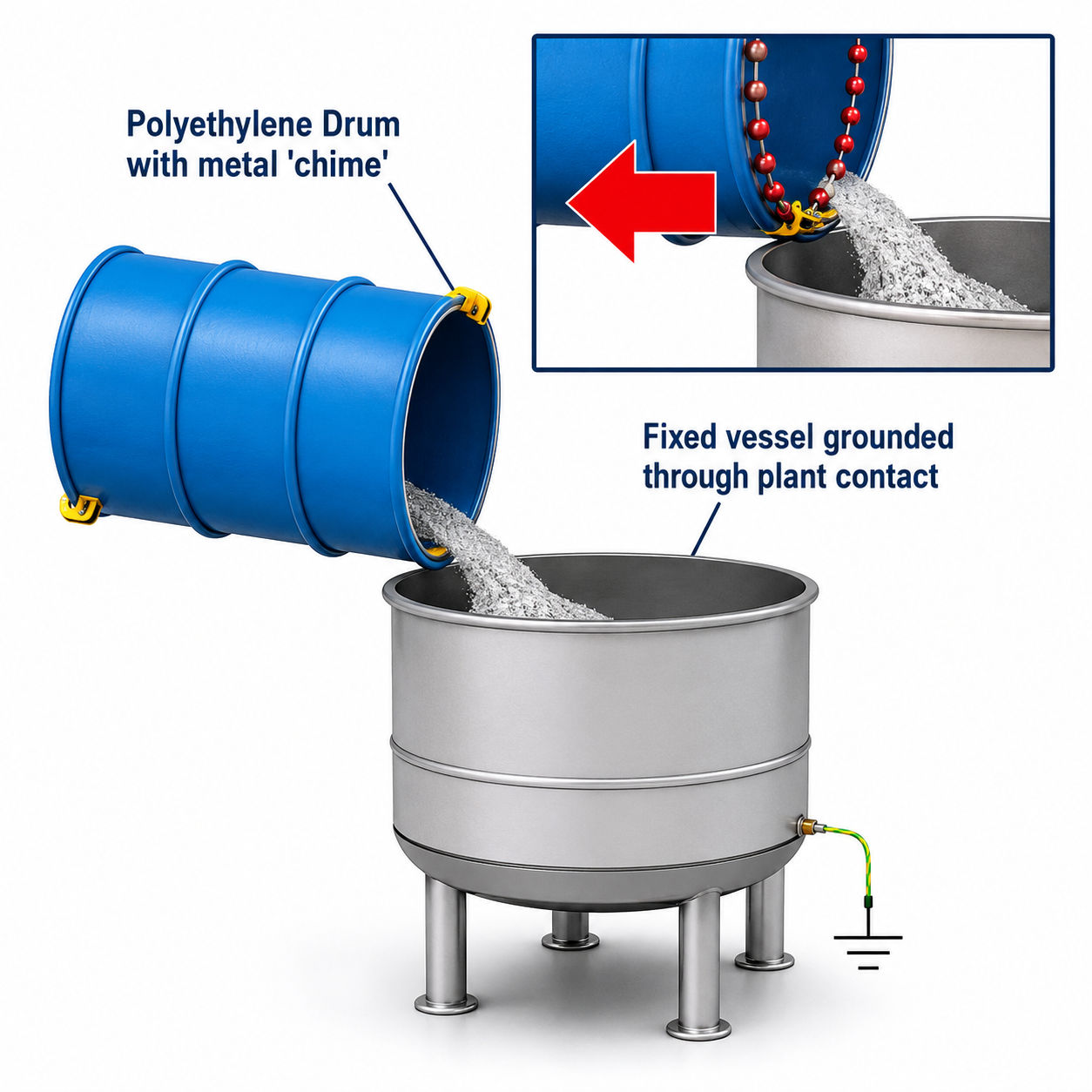
This case study details the ignition of a combustible dust cloud during a manual powder processing operation. An operator was transferring approximately 18 kg (40 lbs) of combustible powder, with a minimum ignition energy of 12 milli-joules, from a polyethylene plastic drum into a metal process vessel. The plastic drum featured a metal 'chime' around its top circumference, intended for impact protection.
As the operator removed the drum from the vessel after depositing the powder, an ignition of the dust cloud formed at the top of the vessel occurred.
Investigation: Postulated Cause and Experimental Verification
It was postulated that electrostatic charge accumulated on the metal chime, leading to a static spark discharge from the chime as it approached the grounded process vessel during removal. To verify this, an experiment was conducted where 18 kg (40 lbs) of the same powder was tipped from a similar drum into a Faraday cage to measure electrostatic charge.
A charge of 3.6 micro-coulombs was measured on the Faraday cage, indicating significant charge generation due to friction between the powder and the plastic drum. A field meter recorded 500 KV/m (the maximum measurable voltage) on an isolated area of the plastic drum, which would have induced charge on the metal chime. The surface area of the chime was approximated at 0.0641 m² (99 in²).
Analysis: Calculating Spark Potential Energy
Assuming the chime reached the maximum charge density possible in air (27 micro-coulombs per square metre), the maximum charge on the chime was calculated to be 1.7 micro-coulombs. With an estimated capacitance of 71 pico-farads for the chime, its voltage would have been approximately 24,000 V (24 KV).
Given the average breakdown voltage of air is 3000 V/mm, this voltage was capable of discharging an electrostatic spark from a distance of at least 8 mm (0.3 inches) to the grounded process vessel. The potential energy of this spark was calculated to be 20 milli-joules, which significantly exceeds the powder's minimum ignition energy of 12 milli-joules.
Conclusion: Static Spark as the Ignition Source
Based on the powder's minimum ignition energy of 12 milli-joules, the confirmed significant electrostatic charging of equipment, and the mitigation of other potential ignition sources, it was concluded that a static spark caused the ignition of the dust cloud around the grounded process vessel.
Preventative Actions and Industry Standards
This incident highlights a common scenario where electrostatic sparking may occur multiple times without incident until a combustible dust cloud is present. The core issue was the electrical isolation of the metal chime, allowing charge to accumulate. Had the chime been connected to the grounded process vessel, excess charge would have safely dissipated to earth.
Industry guidelines, including IEC TS 60079-32-1 (13.4.1) and NFPA 77 (7.4.1.6 & 7.4.1.4), mandate temporary connections using pressure-type grounding clamps. These clamps must apply sufficient pressure to penetrate protective coatings, rust, or spilled material, ensuring a base metal contact with an interface resistance of less than 10 Ohms.
Recommended Static Grounding Equipment
- **FM/ATEX Approved Grounding Clamps:** Devices like the VESX45 dual clamp assembly ensure robust connections. These clamps are designed to penetrate coatings and deposits to make effective contact with the base metal.
- **Ground Status Indicators:** Equipment such as the Bond-Rite® EZ provides visual confirmation of a safe ground. It features a clamp-mounted LED that pulses green when a connection resistance of 10 Ohms or less is established between portable equipment and ground, giving operators a clear GO/NO GO signal for safe operations.
Comprehensive Static Control Measures for Hazardous Areas
Beyond grounding isolated conductors, the use of plastic drums in EX/HAZLOC areas requires attention. While altering resistive powders to enhance conductivity is often impractical, using low-conductivity plastics like polyethylene is not recommended. Charges generated during transfer remain on the drum's surface and can induce charges on other objects and personnel nearby.
Ideally, a metal drum should be used and connected to the grounded process vessel to prevent charge accumulation.
All process operators must also be grounded via static dissipative footwear. This ensures that any charge generated through their movement can safely dissipate from their bodies to the ground, preventing the risk of operator-induced static sparks.
Codes of practice like IEC TS 60079-32-1 and NFPA 77 provide detailed proactive measures for static electricity control. The majority of hazards can be managed through the installation and proper use of static grounding devices, from basic clamps to advanced ground status indicators with process interlocking capabilities.